Excavating a mathematical museum piece
By Burkard Polster and Marty Ross
The Age, 2 June 2008
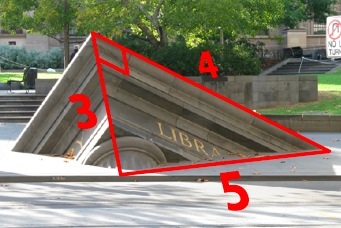
You are probably familiar with Melbourne’s curious corner, sticking out of the Swanston Street footpath, where the Melbourne Museum used to reside. Its official name is Architectual Fragment, and it was created in 1992 by Victorian sculptor Petrus Spronk. It is striking, and it appears vaguely mathematical: we’ll excavate the mathematics.
We can think of the Fragment as the corner of a cube. What you see when you walk around are three right-angled triangles making up the corner. This brings to mind Pythagoras’s Theorem: we are all familiar with the mantra “A squared plus B squared equals C squared”, relating the two shorter sides of a right-angled triangle to the longer side.

Actually, “Pythagoras’s Theorem” may be a misnomer. Pythagoras lived around 500 BC, but his Theorem was known to the Babylonians, over 1000 years earlier. True, the Babylonians seemingly didn’t know how to prove Pythagoras’s Theorem. But, there is no strong evidence that Pythagoras knew how to either!
What the Babylonians did know about were Pythagorean triples: right-triangles with whole number sides. The simplest such triple is 3-4-5, but there are many others. Such triples are not just mathematically pleasing, they are also of practical use. For example, if you are landscaping and need to make a right angle, then take 12 meters of rope and form a 3-4-5 triangle: the large angle will be exactly a right angle.
And this exact technique was applied to make the Fragment. The architect Spronk took a 3-4-5 rope triangle and fixed the 5 meter side to the footpath. He then had a friend hold up the opposite corner and move it up and down until it “looked right”. The sculpture was then constructed from bluestone around a steel frame, and cemented into the footpath.
There is another, much less familiar, Pythagorean gem hiding in the Fragment. Think of the corner as a pyramid, made up of three right-angled triangles and a triangular base (which will not be right-angled). Then the areas A, B, C and D of these triangles are related by the simple formula A2+B2+C2=D2. This beautiful result is known as de Gua’s Theorem, and is about 300 years old: a baby compared to Pythagoras’s Theorem.
But is de Gua’s Theorem really Pythagorean? One way to think of a right-angled triangle is as the corner snipped off a square. Then, de Gua’s Theorem is simply Pythagoras but one dimension higher, for the corner snipped off of a 3-dimensional cube. And you can go further: just put on your 4-dimensional goggles, snip the corner off of a conveniently located 4-dimensional hypercube, and you’ll see what we mean.
Copyright 2004-∞  All rights reserved.