

|
Click on the QEDCAT button above to sign up for the latest news on our articles, presentations and maths movie clips. (Or, send us an email). This website is a collection of fun mathematical resources that we've developed over twenty years. We make the material publicly available in the hope that others may find it useful. We're also available for presentations, lectures, and are generally open to anything mathematical and fun. Send us an email or give Marty a call on 0434332709. NEW MATHS MASTERS BOOK (No, really!): Our latest book Putting Two and Two Together just appeared (January 2022). 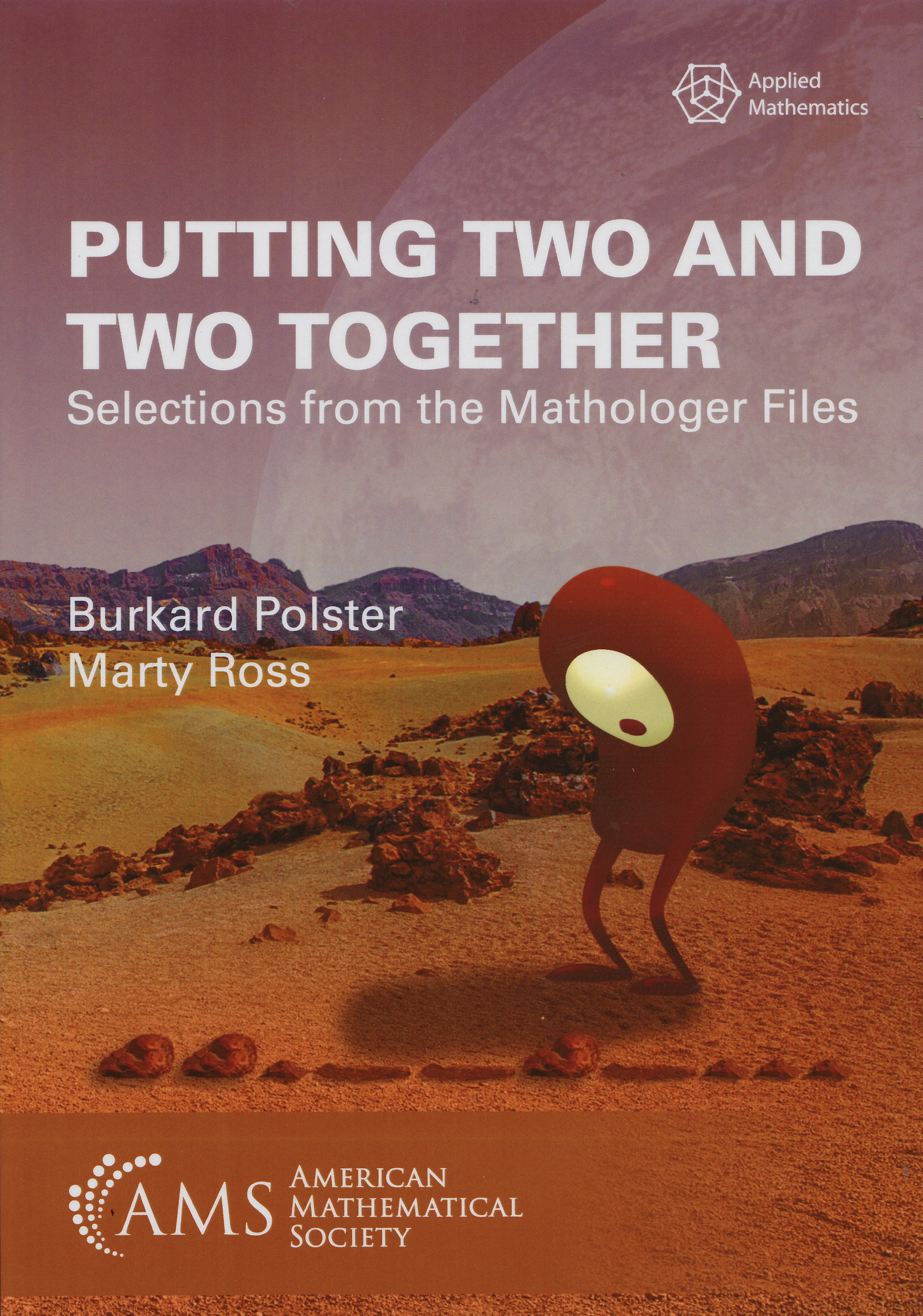
MATHOLOGER: The latest video on Burkard's YouTube Channel.
BAD MATHEMATICS: The latest post on Marty's blog.
|
|
Maths Masters in The Age. Our column in the education section of The Age here in Melbourne from 2007 to 2014. Public Lectures. Fourteen years of our very best lectures. Find out what you have missed and what you can look forward to! The Mathematical Movie Database AND The MTVDB. Companion webpages to our book Math goes to the movies. These are lists of hundreds of movies and TV episodes containing mathematics, plus transcripts of mathematical dialogue found in many of these movies. Our growing collection of streaming mathematical movie clips. Our books... on beautiful proofs, maths in the movies, ambigrams, lacing your shoes, mathematical juggling, etc. Some of our maths articles on how to stabilise wobbly tables, lace your shoes in an optimal way, kick the perfect conversion in rugby, ..., and other irrational thoughts. Maths Education and other nonsense. Some of our articles on Australian mathematics education and the like. Mathsnacks Posters. From 2004 to 2009, the printed version of Mathsnacks lived on the backpages of Vinculum, the quarterly journal for maths teachers, published by the Mathematical Association of Victoria. You can now download six years of Mathsnacks, very suitable for printing and postering! |
Summer Quizzes. Six years of quizzes from our Maths Masters column.
An online course on Measure Theory (Links fixed). Video recordings and accompanying lecture notes of all the lectures that Marty gave at the 2006 AMSI summer school hosted by RMIT university.
QEDcat on TV! An account of our experiences consulting for an episode of City Homicide. Also, don't miss the detailed look at some of the maths that appears in the backgrounds throughout the movie.
Random notes. Standard proofs and expositions we've written for ourselves, or for our classes.
In the media. Every once in a while you can see us in action in newspapers, on radio or on TV (under construction). Finite geometries. Some pages featuring pictures and movies of finite geometries. A blast from Burkard's past.
Function. We've created a temporary home for Function, a mathematics magazine that was published by Monash University's Mathematics Department from 1977 to 2004. |
Copyright 2004-∞  All rights reserved.