An added dimension to can crunching
by Burkard Polster and Marty Ross
The Age, 24 August 2009
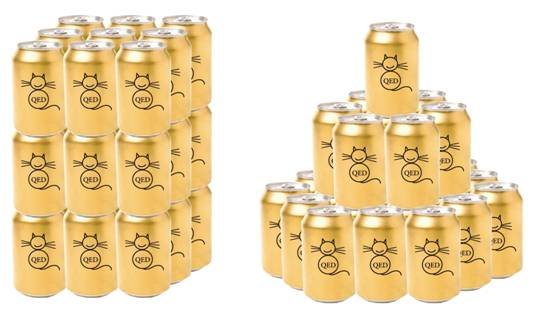
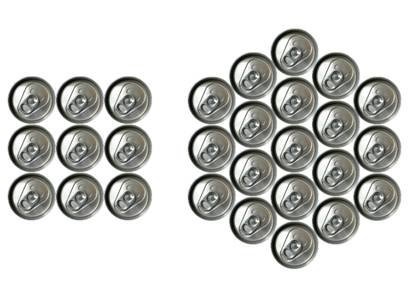
Have a look at the cubical tower on the left and the hexagonal tower on the right. Each has three layers. If offered one tower to keep, which would you choose?
In fact, it doesn’t matter – each tower contains 27 cans. This is no coincidence. No matter how many levels you build into the two towers, one cubical and the other hexagonal, they will always contain the same number of cans.
So, who cares? Probably not shop attendants, who simply want the cans stacked as quickly as possible. But for the mathematically inclined it is a lovely observation. And there is an equally lovely proof.
Take another look at the base of the hexagonal tower. Viewed correctly, the outline of a cube jumps out.
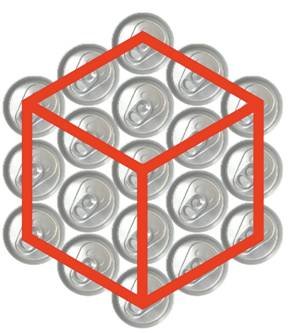
Think of this cube as being made up of 33 = 27 balls. All of the pictured can-tops represent a visible ball. The hidden balls also form a cube of 23 = 8 balls. Therefore there are 33 – 23 = 19 balls that we can see. So, without counting, we can see that the base of the hexagonal tower contains 19 cans. It is also easy to see that there are 7 + 1 cans in the top two layers, summing to a total of 27 cans.
We can now easily sum the cans in any size hexagonal tower, just by repeatedly adding new bases. For example, for a hexagonal tower with four levels we can use cube-perspective to see that the new base contains 43 – 33 cans. We already know that the top three levels consist of 33 cans. So, the whole four-storey tower contains (43 – 33 ) + 33 = 43 = 64 cans.
So, no matter the size, the cubical and hexagonal towers will have the same number of cans. Beautiful towers, and truly beautiful mathematics.
www.qedcat.com
Copyright 2004-∞  All rights reserved.