Shadowlands
Burkard Polster and Marty Ross
The Age, 24 March 2014
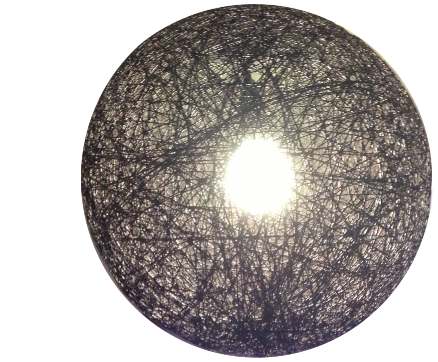
Your Maths Masters recently saved all of Melbourne, raising the alarm when alien spaceships invaded Lygon Street. (You're all very welcome.) Now we're warning of a new threat: large spheres have been seen hovering in the eastern suburbs. Is it time again to head for the hills?
On closer inspection - and we must get into the habit of doing that prior to sounding the sirens - the strange spheres turn out to be restaurant décor. They're very large string lampshades, not from another world, though they are from another time; these massive lampshades were once considered very cool and all but conquered the Earth in the 1970s.
The lampshades are simple to make: just blow up a beachball and wrap it with string soaked in glue. Once the glue has hardened, deflate the beachball and remove it. Very easy though not obviously mathematical.
It was only with his recent encounter in a Melbourne restaurant that one of your Maths Masters was struck by the mathematics exhibited by the lampshades. What is intriguing is that all the shadows cast by the string appear to be straight lines:
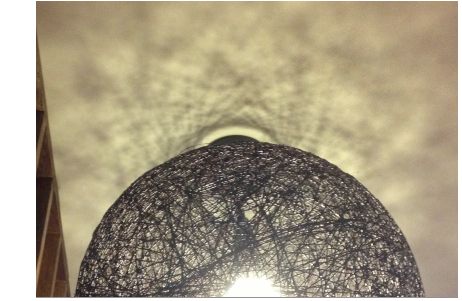
The straightness of the shadows can be explained by considering the lampshade's construction. To keep the string from sliding off the spherical beachball it is important to wrap it approximately along "equators", what are known as great circles. Mathematically, we can obtain any of these great circles by intersecting the beachball with a plane slicing through the centre. Then, the shadow of the circle on the ceiling will be the intersection of the plane with the ceiling, a straight line.
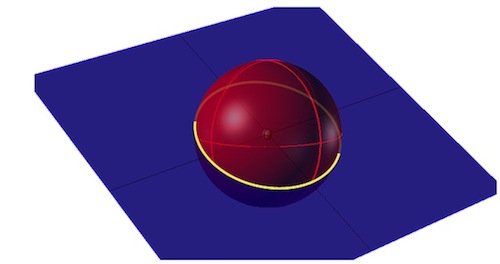
This arrangement is similar to another, very famous and very important method of shadow making. Instead of placing the light bulb at the centre of our spherical shade let's position it at the bottom of the sphere. The sphere will now be useless as a shade for people below, however it can cast some impressive ceiling shadows above.
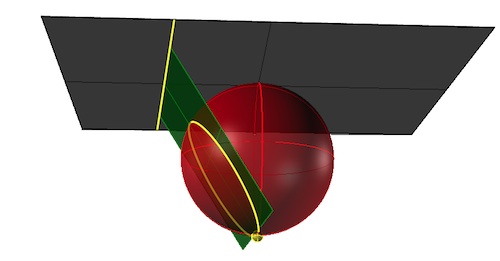
Any circle on the sphere passing through the bulb will cast a straight line shadow on the ceiling. This follows from the same reasoning as for our original lamp, and is illustrated in an excellent video by our friend and colleague Henry Segerman. But there is something even more surprising: any circle on the sphere not passing through the bulb will cast a shadow that is also circular.
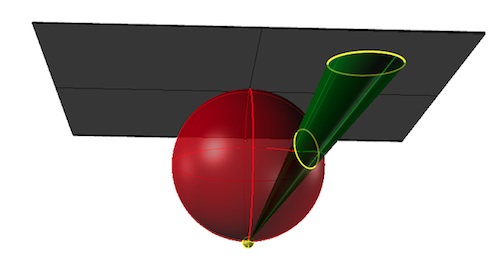
This remarkable property suggests yet another design: construct a lampshade out of circles arranged on a sphere. That is exactly what Henry did (using 3D printing); we can admire the beautiful shadows cast on the ceiling as pictured below, and as demonstrated in Henry's very cool video:
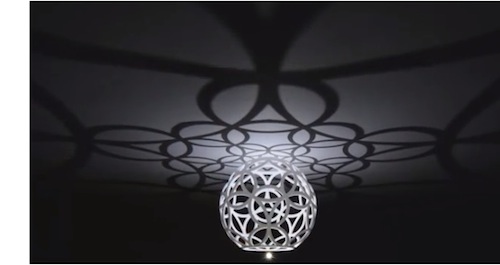
This beautiful method of casting shadows is known as stereographic projection. It was known to the ancient Greeks, and Apollonius of Perga was able to prove the circles-to-circles property we've been admiring. Nowadays, the circle property can be proved either algebraically or geometrically. The proofs are a little too involved to present here, however we can indicate one of the key geometric ideas.
Draw a circle on the ceiling (preferably while the restaurateur has his back turned). Now imagine a cone from the lightbulb to the circle, as pictured in profile below. It is clear that any slice of the cone parallel to the ceiling will also be a circle. What is interesting is that there is another slicing angle that will result in circles.
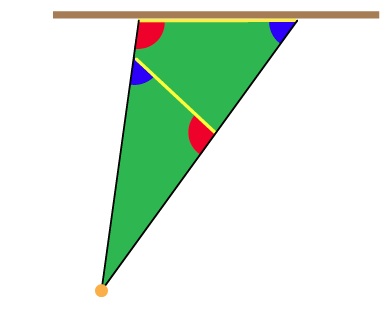
It turns out that if we slice so that the two red angles are equal (implying the two blue angles are also equal), then the cross-section will be a circle. Moreover, one of these circle slices will exactly fit on our sphere, and its shadow will be the original circle drawn on the ceiling. Very pretty! (Admittedly, we've omitted the less pretty details.)
Stereographic projection has a second remarkable property. To explain, we'll replace the lampshade by a transparent globe. The light will now project a map of the Earth onto the ceiling:
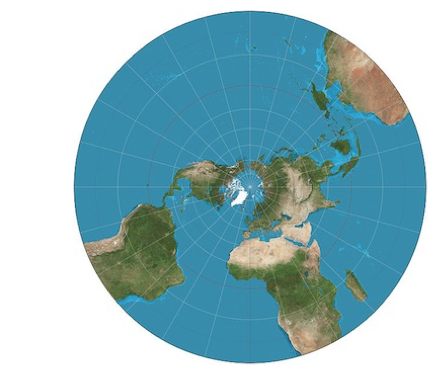
We know that every circle on the Earth will appear as a circle on the map, but something much more important is true: every angle on the Earth will appear as the same angle on the map. For example, if two paths along the earth meet at right angles then the corresponding paths on the map will also meet at right angles. (This is beautifully illustrated by Henry's lampshade above.)
Why is the angle property so important? Because it implies that a compass direction (angle from North) on the map will indicate the true compass direction on the Earth. It is the property that made the similar 1569 map of Gerardus Mercator so revolutionary; in brief, Mercator's was the first world map that reliably indicated which way to go.
So once again your Maths Masters have cried wolf on the alien invasion, but we have been led to some important and beautiful shadow maths. And, as we'll investigate in a future column, there are plenty more surprises hidden in the shadows. Just not any aliens. We think.
Burkard Polster teaches mathematics at Monash and is the university's resident mathemagician, mathematical juggler, origami expert, bubble-master, shoelace charmer, and Count von Count impersonator.
Marty Ross is a mathematical nomad. His hobby is helping Barbie smash calculators and iPads with a hammer.
Copyright 2004-∞  All rights reserved.