Print your own socks
by Burkard Polster and Marty Ross
The Age, 21 January 2011
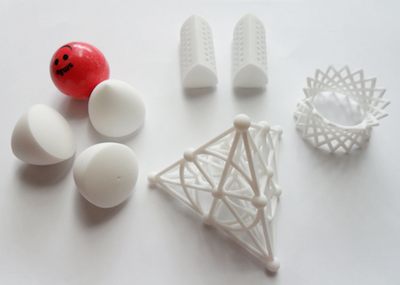
Check out the Maths Masters’ new toys. Some of them may be familiar. For example, we previously wrote about the three white thingos on the left, as strange models for a soccer ball.
What is special about these half-egg objects is they have constant diameter. This means that if you place them on a level table, and then place a book on top of them, the book can glide around at a constant height and without wobbling. You can view the objects at work here.
Similarly, the pictured cylindrical objects work perfectly as rollers. They are based upon constant width manhole covers, which we also wrote about previously.
These are very cool toys, but what is really cool is that we were able to design them ourselves on a computer. Then, we simply placed an order for them to be printed.
Shapeways is a Dutch company that specialises in 3D printing for the general public. To give you an idea how easy it all is, the constant diameter objects took about an hour to design and to upload onto Shapeways' server. Then, it took about ten days for the models to be printed and delivered to Melbourne. The total cost for each model was well below $10.
But how does 3D printing work? Basically, the same way as everyday 2D printing. In normal printing an image is built up line by line. Similarly, in 3D printing the model is built up layer by layer.
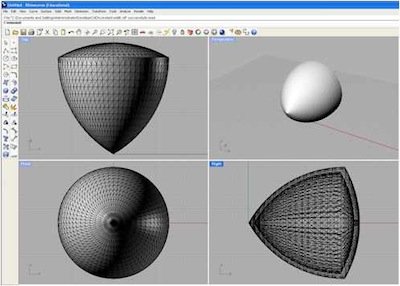
The required layer information is fed to the 3D printer in the form of a 3-dimensional virtual version of the model. This virtual version is produced with CAD (Computer Aided Design) software. For example, pictured below is a virtual version of our constant diameter model, produced with the software Rhino3d.
There are then a number of techniques for performing the 3D printing. Perhaps the most ingenious is Selective Laser Sintering. With this procedure the printer places, one by one, thousands of layers of very fine dust inside a box. The layer at a given height will give rise to the cross-section of the desired object at that height.
After each layer has been placed, a high-powered laser is used to solidify those particles of dust corresponding to the cross-section of the object; the rest of the dust in that layer is left untouched. In this way, a solid object grows, layer by layer, inside a sea of loose dust. Once all the layers are completed, the printer simply blows away the remaining dust, and you have your new toy.
Part of the trickiness but also part of the fun of the 3D design process is figuring out how CAD programs work. These programs are like circle and compass geometry, but for the Space Age: draw a circle in space by choosing three points contained in it; extend planar shapes into cylindrical objects, or spin them around to create solids of revolution; perform set operations to create Frankenstein combo-objects, and on and on. If you want to motivate solid geometry, let your students loose on one of these CAD programs!
And what’s next? The white, plastic models pictured are the default, but Shapeways also allows you to print in color, and to print out of various materials, such as steel and silver. So, it may not be too long before people will be printing their own socks, to go with their self-designed Nike sneakers.
Puzzle to ponder: The following sequence of shapes are the cross-sections of an object at different heights. What object might that be?

Burkard Polster teaches mathematics at Monash and is the university's resident mathemagician, mathematical juggler, origami expert, bubble-master, shoelace charmer, and Count von Count impersonator.
Marty Ross is a mathematical nomad. His hobby is smashing calculators with a hammer.
Copyright 2004-∞  All rights reserved.