π = 3!
by Burkard Polster and Marty Ross
The Age, 16 March 2009
Did you all enjoy March 14? That was Pi Day, when we celebrate the mathematical constant π. Why March 14? That’s because the Americans who came up with the idea write the date as 3.14. Of course 3.14 is not exactly π, just a convenient approximation. But if we really want usefulness together with ease, nothing betters 3 as an approximation to π.
It would be so much more convenient if π were actually 3. For those who take the Bible literally, this is already true. In Kings
He made the Sea of cast metal, circular in shape, measuring ten cubits from rim to rim and five cubits high. It took a line of thirty cubits to measure around it.
Dividing the circumference of 30 cubits by the diameter of 10 cubits, we conclude that π = 3.
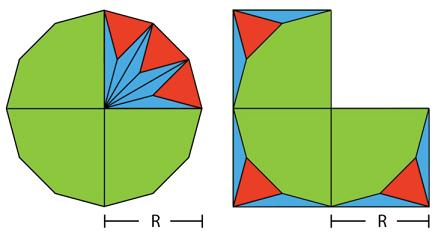
That is just silliness of course, but here is something true, and quite amazing. Have a look at the two diagrams. One is a regular 12-sided polygon, known as a dodecagon – the shape of a 50-cent coin. The other diagram consists of three squares of sidelength R.
Notice that you can transform the dodecagon into the three squares, simply by rearranging the blue and red triangles. It follows that the two shapes must have exactly the same area. Of course, the area of the three squares is 3R2. So, the area of the dodecagon with “radius” R is also exactly 3R2!
Now, since the area of a “circle” of radius R is πR2, we know exactly how to arrange things so that π is exactly 3. Our Maths Masters plan for a better universe is simply to replace all circles with dodecagons. Mathematical life would be so much easier!
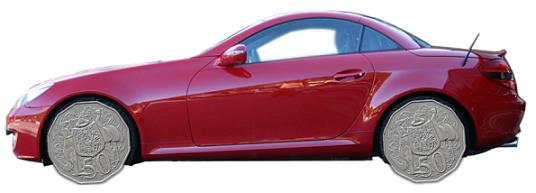
But perhaps, having glanced at our sports car, you are somewhat skeptical of the value of this ingenious plan. Still, at least you now know the easy way to calculate the area of a 50-cent coin.
Copyright 2004-∞  All rights reserved.