Scissors cut paper cover rock
by Burkard Polster and Marty Ross
The Age, 5 November 2007
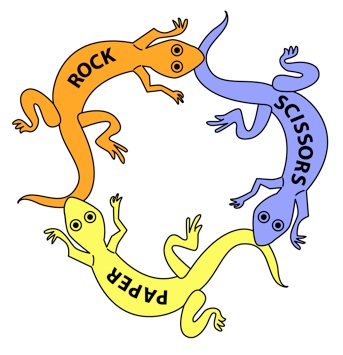
The game of Rock Paper Scissors (RPS) is a childhood perennial. It has perhaps the simplest rules possible - S beats P beats R beats S - but can be engaging both for children and adults (especially when the adults are competing to see who changes a nappy). Can anything be said about such a simple game? Presumably something can be said, since the National RPS Championships have just been held on the Gold Coast, with the winner now going on to the International Championships.
The question to ask of any game is whether there are better and worse ways to play it, and there are clearly bad ways to play RPS. For instance, if you bought a pet rock in the 80's, and thus have a penchant for choosing Rock, then your opponent can obviously capitalise by playing Paper.
The generalisation of this is, if there is any obvious pattern to your choices then a keen-eyed competitor can beat you. The solution, then, is to play all three possibilities 1/3 of the time, in as random a fashion as possible. (If your opponent is exceptionally unobservant, you can roll a die, playing Rock for a roll of 1 or 2, Paper for 3 or 4, and Scissors for 5 or 6). The effect of this is that, no matter what your opponent does, you'll have a 50-50 chance of winning.
But what if you want a better chance of winning? Of course, beating a Rocklover is easy. And, if your opponent is a recalcitrant mathematician then there is nothing you can do. But if you are both mathematicians and are both keen on winning, then it becomes a game of patience and observation. You can play randomly until you detect a pattern to your opponent's play, and then pounce. Of course, your opponent may actually be playing randomly, and it only looks like a pattern: if so, your opponent can pounce upon your mistimed pounce!
The cyclical nature of RPS is intriguing, and even more intriguing is the fact that such cyclical competitions exist in nature. As reported in the journal Nature, the biologists Sinervo and Lively investigated a species of blotched lizards in the Californian desert. They observed that blue-throated males defend a territory large enough for just one female. These blue males are dominated by orange males, which control large territories with many females. But, in turn, orange males are susceptible to invasion by yellow males, whose markings mimic those of females. To complete the cycle, once yellow males are common, they are vulnerable to the single-minded blue males. The result is an on-going game of RPS, with cyclical population patterns.
Copyright 2004-∞  All rights reserved.