So you think you can beat the bookies?
by Burkard Polster and Marty Ross
The Age, 1 November 2010
In this era of economic (pseudo) rationalism, you’ve got to admire a city that takes a day off for a horse race.
We love the Melbourne Cup. We don’t love horseracing, but the general frivolity warms our hearts. And, we’re intrigued by its much less frivolous heart: the mathematics of gambling.
Is it possible to make money - reliably - gambling on horse races? Yes, of course it is, and it requires very little mathematics: you simply have to be a very good judge of horseflesh. There are gamblers who succeed at this, but it is hard work. You need to know the horses very well to overcome the fact that the payouts are rigged against you.
Essentially all gambling games are rigged, so that the company offering the game is guaranteed a profit. That’s not a surprise, and it’s hardly unreasonable. What is much less reasonable is that the extent of the rigging is rarely made explicit. We suspect that few punters have any real sense of the rigging.
Luckily, there’s a simple method to work this out. If you bet just the right amounts on the possible outcomes then, no matter who eventually wins, you’ll know the exact sum that you’ll get back. Then, the rigging is indicated by comparing the total amount of money you’ve wagered to the sum that will be returned.
To see the method in practice, suppose you want to bet on the upcoming Ashes cricket series. At the time of writing, Sportsbet is offering the following prices:
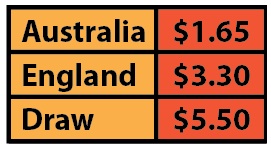
The table indicates, for example, that a winning $100 bet on England will return $330, for a profit of $230. Now, you may regard that $3.30 as good odds against a less than impressive Australia: maybe Sportsbet has it wrong. But, independent of judging cricketflesh, you can measure the extent to which the odds are intrinsically rigged: to do this, you simply take the reciprocals of all the payouts, and add.
For our Ashes example, the calculation is
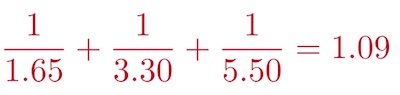
That 1.09 indicates that betting a total of $109 on the three possible outcomes (in just the right proportions) will guarantee you a return of exactly $100, no matter how the series unfolds. Then, the extra $9 you are required to wager indicates the extent of the rigging. (As part of the puzzles below, we indicate the way to determine the exact bets involved).
We can now apply exactly the same method to consider potential bets on the Melbourne Cup. Below is the table of payouts offered (at the time of writing) by a number of online betting sites.
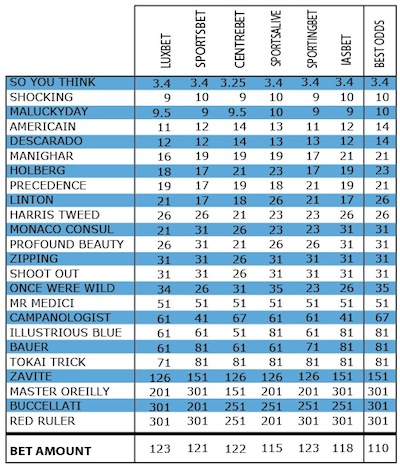
The last row of the table indicates the amount to wager to guarantee a return of $100. Not surprisingly, this amount is always greater than $100, and in fact none of the sites is offering enticing odds. Sportsalive is the best of an unattractive bunch.
So, what should you do? If you have simply decided on the horse you fancy, then you just choose the best site for that horse: Sportsalive for Maluckyday, Centrebet for Americain, and so on.
However, you can also reduce the overall rigging, by choosing the best site for each horse. Indeed, if you’re lucky, the rigging may disappear entirely, guaranteeing a $100 return on less than $100 wagered. This is a famous approach to gambling, known as arbitrage betting.
In the last column of our table, we’ve identified the best payout for each horse, and the final entry in the column indicates the overall rigging. As you can see, you still need to lay out $110 to guarantee a $100 return: still not at all enticing.
And, after all this, how will your carefully calculating Maths Masters be betting on the Melbourne Cup? Well, we plan to slap a few dollars down on Profound Beauty. We like the name.
Puzzles to Ponder: Suppose you make the following three bets on the Ashes: $18.15 on Australia; $9.08 on England; and $5.45 on the draw. So, the total wagered is $32.68. How did we come up with those bet amounts, and how much money will be returned to you when the Ashes is decided? How much should you wager on each of the possible outcomes to ensure you’ll receive back $100?
Now, suppose Centrebet has a change of heart: they decide to keep all the payouts on the Melbourne Cup the same, except that they increase the payout on So You Think so that there is no overall rigging. What would their new payout then be for So You Think?
Burkard Polster teaches mathematics at Monash and is the university's resident mathemagician, mathematical juggler, origami expert, bubble-master, shoelace charmer, and Count von Count impersonator.
Marty Ross is a mathematical nomad. His hobby is smashing calculators with a hammer.
Copyright 2004-∞  All rights reserved.